Buffalo grew fast during the Erie Canal era, packing factories and homes onto filled marshland and lake plains. That history sits directly under today's foundations. The water table here often sits just a few feet below grade, especially south of downtown near the Buffalo River. A proper geotechnical drainage design prevents the slow saturation that turns clay till into a bearing failure risk. We pair that drainage analysis with a permeability test in the field to measure actual flow rates, not textbook estimates. It is the only way to size a system for Buffalo's layered glacial soils.
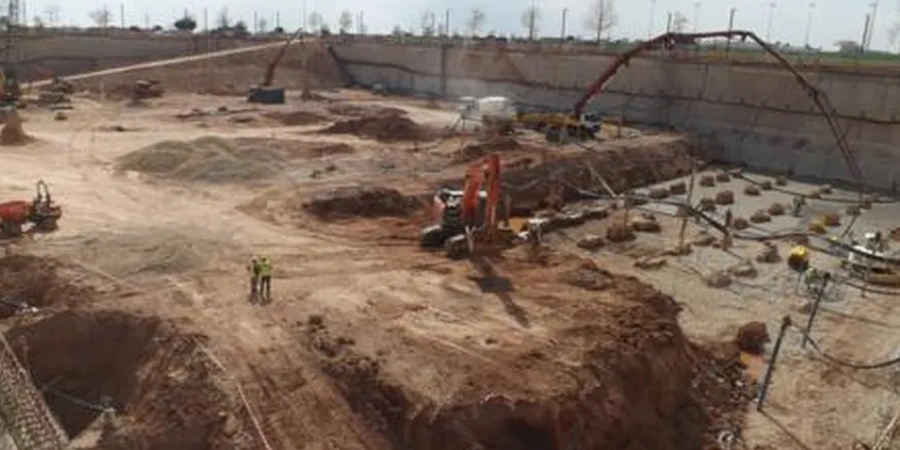
A drainage system sized on textbook k-values alone will fail in Buffalo's lacustrine clays. Field data is non-negotiable.
Method and coverage
- Field permeability testing via falling-head or constant-head methods to establish k-values in the actual till and lacustrine deposits.
- Piezometer installation for long-term groundwater monitoring across freeze-thaw cycles.
- Sizing of trench drains, blanket drains, and sump systems based on the measured hydraulic gradient.
Regional considerations
Lake Erie's lake-effect snow is only half the story. The real subsurface problem in Buffalo is the perched water table sitting above the hard clay till. This layer traps water during spring thaw and after heavy rain, creating hydrostatic pressure against any basement wall or slab. Without a targeted geotechnical drainage design, that pressure pushes water through joints and cracks. Worse, it can soften the bearing stratum under shallow foundations. We have seen it cause differential settlement in houses just off Elmwood Avenue. A perimeter drain tied to a sump pump is the standard fix, but without field-verified k-values the pipe diameter and gravel envelope are guesses.
Standards that apply
ASCE 7-22 (Chapter 3: Flood Loads and Drainage), IBC 2021 (Chapter 18: Soils and Foundations), ASTM D2434 (Constant Head Permeability), AASHTO M288 (Geotextile Specification), FHWA NHI-05-038 (Subsurface Drainage Manual)
Complementary services
Perimeter Drain and Sump System Design
Sizing of perforated pipe, gravel envelope, and sump basin based on site-specific inflow rates from field permeability testing.
Foundation Drainage for Retaining Walls
Weep hole design, geotextile filter layers, and gravel backfill specifications to prevent hydrostatic build-up behind basement and retaining walls.
Subsurface Drainage for Slab-on-Grade
Capillary break layers, vapor barriers, and drainage mats designed to manage moisture migration through concrete slabs in Buffalo's wet climate.
Typical parameters
FAQ
How deep are drainage trenches typically installed in Buffalo?
Trench depth depends on the frost line and water table. In Buffalo the frost depth is about 42 inches (1.07 m) per code. We set the drain invert below the frost line but above the seasonal high water table. For most residential projects that means 4 to 5 feet deep. We confirm depth with a test pit or hand auger during the site visit.
What is the typical cost range for a geotechnical drainage design in Buffalo?
A complete design package with field testing and stamped drawings runs between US$900 and US$2,220. The variation depends on site access, number of test holes, and whether we need continuous monitoring through a wet season. We provide a fixed quote after the initial walk-through.
Do you design drainage for sites with existing basements?
Yes. Retrofitting a perimeter drain around an existing foundation is more complex, but we have completed dozens of retrofits in Buffalo's older neighborhoods. We use trenchless methods where possible to avoid undermining the footing. The design includes a sump pit and pump sizing based on the measured inflow rate from the existing weeping tile.
What happens if the soil permeability is very low?
Low k-values in clay till mean the water moves slowly but does not stop. In that case we specify a wider gravel envelope and a larger-diameter collector pipe to capture lateral flow over a longer period. We may also add a geotextile wrap to prevent fines migration into the gravel. The design always accounts for the actual measured k-value, never a table value.