We deploy optical survey targets and vibrating-wire extensometers on Buffalo's lake-plain clays to track vertical movement in real time. The city sits on a deep sequence of glacial till and soft lacustrine deposits left by proglacial Lake Warren — soils that creep under sustained load. Our rigs install settlement plates and inclinometer casing before a single foundation pour begins. For sites near the Buffalo River, where organic silts are common, we pair direct measurement with a placa de carga to calibrate modulus values against actual plate deflection. Every data point feeds back into the prediction model we build for your project.
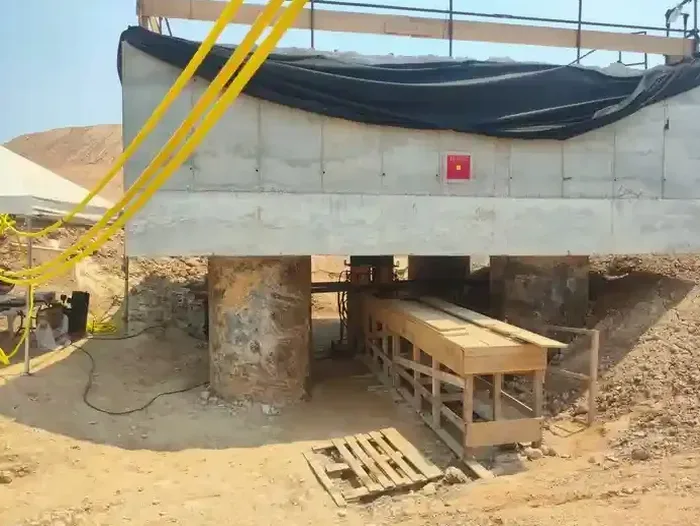
Glacial till and lacustrine clay in Buffalo can settle unevenly for decades if the pre-consolidation pressure is not measured in the lab.
Method and coverage
Regional considerations
A common mistake we see in Buffalo is contractors pouring slab-on-grade over uncompacted wet fill without any settlement analysis. Within two winters the slab corners drop 30–50 mm, cracking the foundation wall and breaking utility lines. The real trap is assuming the glacial till layer is rigid enough to ignore — but the soft clay above it can squeeze laterally under loading, producing differential movement that no amount of rebar can fix. We flag these risks early by correlating our settlement predictions with actual site topography and drainage history.
Standards that apply
ASCE 7-22 (Minimum Design Loads, Section 12.13 Settlement), IBC 2021 (Table 1604.3 – Allowable Deflection), ASTM D2435 (One-Dimensional Consolidation Test), ASTM D4546 (Swelling/Consolidation of Soils)
Complementary services
Laboratory Consolidation Testing for Glacial Clays
Incremental loading consolidation tests on undisturbed thin-wall samples from Buffalo's lacustrine clays. We report pre-consolidation pressure, compression index, and coefficient of consolidation. Results feed directly into your foundation design and are cross-referenced with field plate load data.
Field Monitoring with Settlement Plates and Extensometers
Installation of surface settlement plates and magnetic extensometers at multiple depths. We monitor vertical displacement during fill placement, surcharge, and foundation construction. Weekly reports include time-settlement curves and comparisons to predicted values, allowing real-time adjustments to the construction sequence.
Typical parameters
FAQ
How long does a settlement analysis take for a Buffalo residential project?
For a typical single-family home on glacial till with soft clay beneath, we complete lab consolidation tests and deliver a settlement prediction report within 3 to 5 business days after receiving undisturbed samples. Field monitoring during foundation work can extend the timeline by 2 to 4 weeks depending on weather and site access.
What is the typical cost range for settlement analysis in Buffalo?
The cost for a complete settlement analysis including lab consolidation testing and a written report ranges from US$710 to US$1,750, depending on the number of samples and the depth of the investigation. Field monitoring with settlement plates adds US$400–US$800 per month of observation.
Can settlement analysis predict differential movement between adjacent buildings?
Yes. Our analysis models differential settlement by comparing the stress distribution under each foundation footprint and the compressibility of the underlying clay. For buildings on the same glacial till layer but with different loads or foundation sizes, we calculate the angular distortion and compare it against the IBC allowable limit of 1/300. This is critical in Buffalo's older neighborhoods where new additions abut existing structures.