Buffalo sits at 600 feet above sea level on the eastern shore of Lake Erie, where annual lake-effect snowfall exceeds 90 inches in some suburbs. The deep glacial till and clay deposits left by the last ice age create variable soil conditions that directly affect retaining wall design. A wall that works in sandy coastal soil may fail here without proper geotechnical input. That is why we start every project with a thorough site investigation, including test pits to verify stratigraphy and SPT borings to measure blow counts in the dense till layers. Our team tailors every retaining wall design to Buffalo specific subsurface profile.
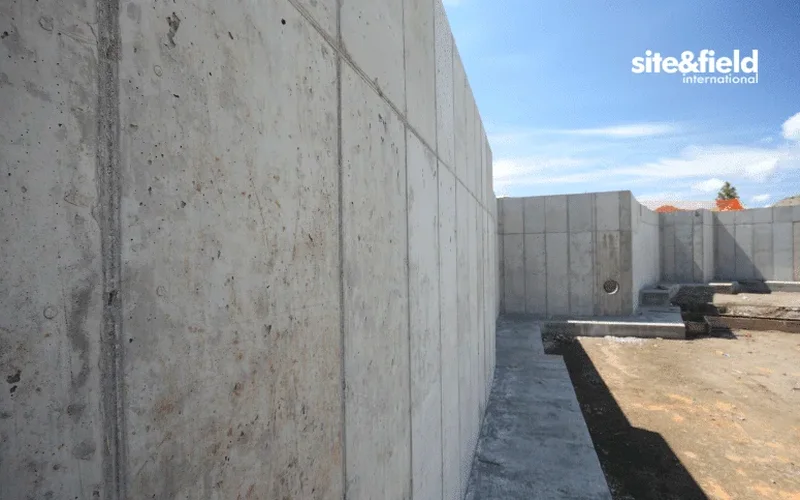
Glacial till in Buffalo can exceed 100 blows per foot — retaining wall design must account for that stiffness.
Method and coverage
- Determining active and passive earth pressures per Coulomb and Rankine theory
- Checking global stability with Bishop and Spencer methods
- Evaluating seismic increments per ASCE 7 for the local site class
Regional considerations
Lake Erie water levels fluctuate several feet annually, and Buffalo receives over 40 inches of rain per year. That combination saturates backfill quickly, increasing hydrostatic pressure behind a wall. If the retaining wall design does not include a proper drainage layer and weep holes, the added water pressure can double the lateral load. We have seen block walls bow outward and concrete walls crack within two winters. Our lab specifies gravel drains, geotextile filters, and perforated pipe systems to keep the backfill dry. Freeze-thaw cycles here also mean we check the frost depth — typically 42 inches in Buffalo — and place wall footings accordingly.
Standards that apply
AASHTO LRFD Bridge Design Specifications (9th Edition), IBC 2021 Section 1807 (Retaining Walls), ASCE 7-22 Seismic Load Provisions
Complementary services
Gravity and Cantilever Wall Design
For walls up to 12 feet tall, we design reinforced concrete cantilever or masonry gravity walls. Output includes overturning, sliding, and bearing pressure checks per IBC 2021.
Mechanically Stabilized Earth (MSE) Walls
Ideal for highway embankments and commercial sites. We size the reinforcement length and vertical spacing based on the actual friction angle of Buffalo till, not generic values.
Anchored and Tied-Back Walls
When space is tight or walls exceed 15 feet, we design anchored systems with soldier piles and tiebacks. We verify bond length through pullout tests on local soils.
Typical parameters
FAQ
What is the typical cost for retaining wall design in Buffalo?
The range is between US$1,100 and US$4,380 depending on wall height, soil conditions, and the number of design iterations required. Contact us for a scope-specific quote.
Do I need a geotechnical report before designing a retaining wall?
Yes. Without soil shear strength and groundwater data, the retaining wall design is guesswork. We recommend at least two borings or test pits per wall alignment to define the stratigraphy.
What loads are considered for retaining walls in Buffalo?
We calculate active, passive, and at-rest earth pressures plus surcharge loads from adjacent structures, traffic, and seismic acceleration per ASCE 7. For walls near Lake Erie we also include wave or ice thrust if applicable.
How does freeze-thaw affect retaining wall design?
Frost heave can lift a wall footing if it is above the frost line. In Buffalo the frost depth is 42 inches, so we place footings at least 48 inches deep. We also specify non-frost-susceptible backfill to reduce heave potential.
Do you design walls for lateral earth pressure only?
No. We also check bearing capacity, sliding resistance, overturning, and global stability. If the wall is on a slope we run slope stability analysis using Bishop or Spencer methods to confirm the factor of safety exceeds 1.5.