Buffalo sees over 90 inches of snow annually and sits on glaciolacustrine clays left by Lake Erie’s post-glacial recession. These fine-grained soils, often soft to very soft, demand careful geotextile specification to prevent clogging and ensure long-term drainage. Before selecting a fabric, we assess the site’s natural water table and particle size distribution. Many local projects combine this with a placa de carga test to verify subgrade bearing capacity under saturated conditions. The wrong geotextile can turn a stable slope into a maintenance problem within two winters.
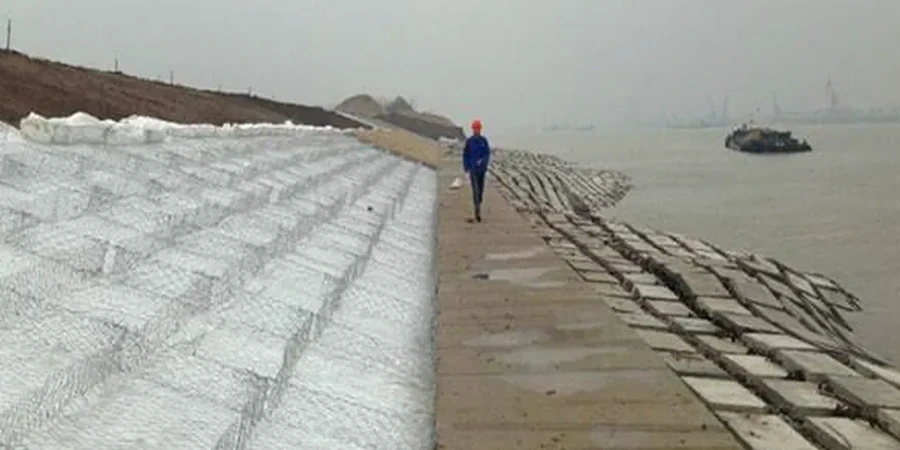
A geotextile specified without site-specific soil data is a gamble — one that often fails during Buffalo’s spring thaw.
Method and coverage
Regional considerations
Buffalo sits at 600 feet above sea level and has a frost depth of 42 inches. Repeated freeze-thaw cycles in these clay soils cause differential heave that can rupture a poorly specified geotextile. When the fabric tears, fines migrate into the aggregate, clogging drains and accelerating pavement failure. We have seen parking lots and retaining walls fail within three winters because the geotextile specification ignored the local frost action. Our team cross-checks each specification against IBC Chapter 18 and ASCE 7 frost criteria before release. A correct geotextile specification is not expensive; a repair after frost damage is.
Standards that apply
ASTM D4751-21 (AOS), ASTM D4491-22 (Permittivity), AASHTO M288-21 (Geotextile Standard), ASTM D4632-21 (Grab Tensile), ASTM D6241-22 (CBR Puncture)
Complementary services
Separation Geotextile Specification
For roads and parking lots over soft subgrade, we specify woven or nonwoven fabrics based on CBR values from In-Situ. The report includes AOS and grab strength minimums to prevent aggregate loss and rutting.
Filtration and Drainage Geotextile Specification
For retaining walls, French drains, and slope interceptor drains, we calculate permittivity and soil retention ratios. We verify compatibility with local glacial till and lacustrine clays using gradation curves.
Typical parameters
FAQ
What is the difference between a woven and nonwoven geotextile for Buffalo soils?
Woven geotextiles are stronger and better for separation under high loads, like road bases over soft clay. Nonwoven geotextiles have higher permittivity and are preferred for filtration in drainage systems where clogging risk is higher. Our specification matches the fabric type to the soil’s gradation and the project’s hydraulic demand.
How much does a geotextile specification report cost in Buffalo?
A full specification report, including soil classification and fabric selection, ranges between US$430 and US$1,360 depending on the number of test locations and required laboratory tests. This covers site review, gradation analysis, and a written document ready for contractor bid.
Do I need a geotextile under a gravel driveway in Buffalo?
Yes, especially on the clay subgrades common in Buffalo. Without a separation geotextile, gravel punches into the soft clay within a few freeze-thaw cycles. Our specification ensures the fabric prevents intermixing and maintains driveway stability for years.
What ASTM standards apply to geotextile specification in New York?
The primary standards are ASTM D4751 for apparent opening size, ASTM D4491 for permittivity, and ASTM D4632 for grab tensile strength. AASHTO M288 is the performance-based standard most NYSDOT projects reference. Our reports cite all relevant versions.