Buffalo's geology is defined by deep glaciolacustrine clays and silts deposited by ancient Lake Iroquois, often underlain by glacial till. These layered soils present a unique challenge: the upper clay crust can provide deceptive stiffness, while softer zones below may control settlement. A Standard Penetration Test (SPT) is the most reliable way to capture this variability at depth. We perform SPT borings in accordance with ASTM D1586 to measure N-values every 1.5 meters, giving us a continuous resistance profile. For shallow foundations on the stiff clay crust, we often pair SPT data with plate load tests to calibrate modulus values directly. This combination helps us distinguish between the firm surface layer and weaker underlying strata that could affect long-term performance.
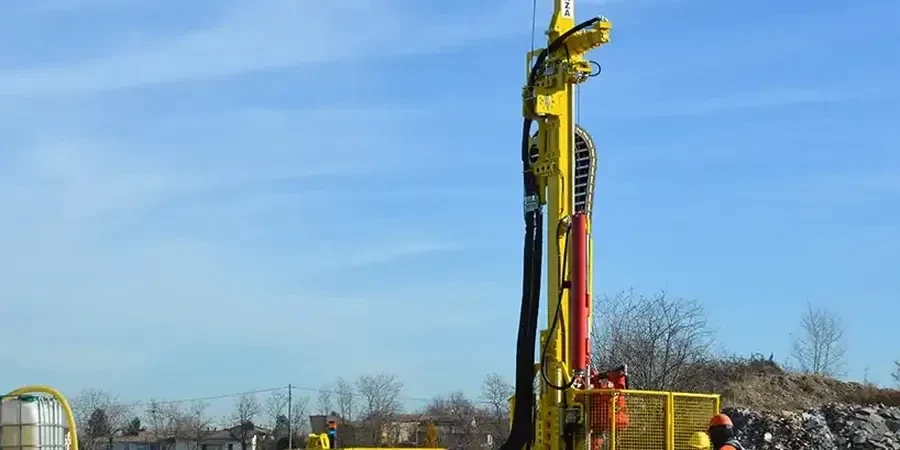
N-values dropping from 12 to 2 blows per foot within 6 meters of depth: a common pattern in Buffalo's varved clay deposits that only SPT can reliably capture.
Method and coverage
Our field procedure includes:
- Automatic trip hammer with energy measurement per ASTM D1586
- Split-barrel sampling for retrieval of disturbed soil for classification
- Continuous logging of blow counts and soil description by a certified geologist
Regional considerations
Buffalo sits within Seismic Category B per IBC 2021, but the presence of soft lacustrine clays creates a site class D or even E condition, amplifying ground motion significantly. A 2022 UB study found that sites along the Lake Erie shoreline could experience peak acceleration 1.4 times higher than those on glacial till. SPT N-values are the primary input for liquefaction triggering analysis using the Youd-Idriss (2001) method. In a city where lake-effect snow and freeze-thaw cycles already stress infrastructure, underestimating seismic site response through insufficient SPT data is a risk no engineer should take.
Standards that apply
ASTM D1586-18 (Standard Test Method for SPT), AASHTO T-206 (Standard Method of Test for SPT), IBC 2021 Section 1803 (Geotechnical Investigation)
Complementary services
Standard SPT Boring
Continuous SPT sampling at 1.5 m intervals with split-spoon retrieval for visual classification and laboratory testing. Includes N-value logging and bore log preparation per ASTM D1586. Suitable for low-rise residential and commercial projects where general stratigraphy is needed.
Advanced SPT with Seismic Interpretation
Extended SPT program with energy measurement, hammer calibration, and correlation to vs30/" data-interlink="1">shear wave velocity (VS30) for site class determination. Includes liquefaction assessment per NCEER guidelines. Recommended for mid-rise buildings, bridges, and critical infrastructure in Buffalo's lacustrine zones.
Typical parameters
FAQ
How does SPT differ from CPT for Buffalo clay soils?
SPT provides disturbed soil samples for classification and lab testing, which is critical for identifying varved clay layering and organic content. CPT gives a continuous profile of tip resistance but does not retrieve soil. In Buffalo's glaciolacustrine deposits, SPT is preferred when precise soil identification is needed for settlement analysis.
What N-values are typical for Buffalo's lacustrine clay?
In the upper stiff crust, N-values typically range from 6 to 12 blows per foot. Below 4 to 6 meters, in the softer varved clay, values often drop to 2 to 5 blows per foot. These low N-values are consistent with soft to medium-stiff clay and indicate potential for significant consolidation settlement under load.
What is the cost range for an SPT boring in Buffalo?
The typical cost for an SPT boring in the Buffalo area ranges from US$600 to US$860 per borehole, depending on depth, access conditions, and number of samples. Mobilization for equipment and any required traffic control can add to the total. We recommend getting a site-specific quote for accurate budgeting.
When should I use SPT versus a test pit for my Buffalo project?
Use test pits for shallow investigations down to 4 meters where you need to see soil structure in situ. Use SPT when you need to characterize deeper strata, particularly the soft lacustrine clays below 5 meters, or when you need N-values for bearing capacity and liquefaction analysis per IBC 2021.