Buffalo's development along the Lake Ontario shoreline and the Erie Canal corridor carved much of the city's identity, but it also left a legacy of steep slopes in native glacial till and lacustrine clays. These deposits, laid down by retreating ice sheets, often contain sensitive varved clays that lose strength rapidly when saturated. We see this most clearly in the residential neighborhoods south of Delaware Park, where retaining walls crack and pavements tilt. A thorough slope stability analysis in Buffalo must account for perched water tables and the softening effect of Lake-effect snowmelt. Before we run limit-equilibrium models, we often begin with a calicata exploration to log stratigraphy and find those hidden seepage layers that drive instability. That field data feeds directly into our Bishop and Spencer methods, calibrated with local soil parameters.
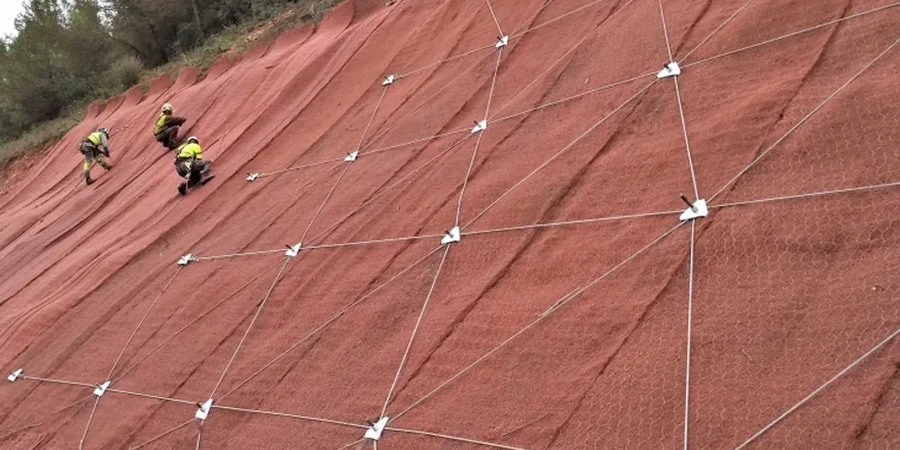
Varved clays can lose 30% of undrained shear strength under cyclic loading — that is why post-seismic stability checks are mandatory in Buffalo.
Method and coverage
Regional considerations
Our crew sets up total stations and inclinometers along the bluff crests in South Buffalo and the Ohio Street corridor, measuring horizontal displacements over a 90-day monitoring period. The biggest risk in these slopes is a rapid drawdown scenario after a heavy Lake Ontario storm — the water table drops faster than the clay can drain, creating excess pore pressures that can trigger a sudden failure. We have seen cracks open 2 inches wide overnight in the Fillmore Avenue area. That is why we install vibrating-wire piezometers at 5-foot intervals along the failure plane and tie them into a real-time dashboard that alerts us when pore pressures exceed 80% of the overburden stress. Early warning gives the contractor time to unload the crest or install temporary dewatering wells.
Standards that apply
FHWA-NHI-05-089 (Slope Stability Reference Guide), ASCE 7-22 (Minimum Design Loads and Associated Criteria), ASTM D3080-18 (Direct Shear Test), ASTM D4767-20 (Consolidated Undrained Triaxial)
Complementary services
Limit Equilibrium Analysis
We use SLOPE/W and Slide2 to run Bishop, Spencer, and Janbu methods on 2D cross sections. Each model incorporates stratigraphy from test pits and borings, groundwater from standpipe readings, and shear strength from lab tests. We deliver a factor of safety for every potential failure surface and a sensitivity chart showing how safety changes with water level or cohesion.
Finite Element Deformation Modeling
For complex slopes with variable stratigraphy or adjacent structures, we run Plaxis 2D to model stress redistribution and deformation before failure. This is especially useful in the Buffalo River corridor, where old bulkheads and buried utilities interact with natural slope movements. Output includes displacement vectors, shear strain contours, and pore pressure fields.
Instrumentation and Monitoring
We install inclinometers, vibrating-wire piezometers, and surface survey monuments to track real-time slope behavior. Data is logged via cellular telemetry and accessed through a web dashboard. Alerts trigger when movement exceeds 0.1 inches per week or pore pressure exceeds 80% of overburden, giving you time to act before a failure event.
Typical parameters
FAQ
What is the typical factor of safety used for slope stability in Buffalo?
We follow FHWA guidelines: 1.5 for static conditions, 1.1 for pseudo-static seismic, and 1.2 for post-seismic residual strength. For temporary excavations or construction slopes, we may accept 1.3 static with a higher monitoring frequency. These values are based on the city's moderate seismic hazard and the sensitive nature of the lacustrine clays.
How does Lake Ontario water level affect slope stability in Buffalo?
Rapid drawdown after a lake storm is the most dangerous scenario. When the lake level drops quickly, the water table inside the slope stays high, creating excess pore pressure that reduces effective stress. This can lower the factor of safety by 0.3 to 0.5 in a matter of days. That is why we recommend continuous piezometer monitoring during the spring thaw and after heavy rainfall events.
What soil parameters are most critical for the analysis?
Peak and residual friction angles from direct shear tests on undisturbed samples, along with undrained shear strength from triaxial compression. For Buffalo's varved clays, the anisotropy ratio (horizontal vs. vertical permeability) can be as high as 10:1, so we run consolidation tests to measure cv and ch separately. Cohesion is usually low (50–200 psf) and highly sensitive to water content.
How much does a slope stability analysis in Buffalo cost?
A typical analysis including field reconnaissance, lab testing, modeling, and a written report ranges from US$1,420 to US$3,740. The final cost depends on the number of cross sections, the depth of borings required, and whether instrumentation and monitoring are included. We provide a firm fixed-price quote after reviewing the site geometry and available geotechnical data.