Geotechnical laboratory testing forms the backbone of safe and economical construction across Buffalo and Western New York. This category encompasses the physical and mechanical evaluation of soil and rock specimens under controlled conditions, delivering the parameters engineers need to design foundations, retaining structures, and earthworks. From routine index tests to advanced strength and deformation analyses, the laboratory transforms field samples into actionable data. In a region where glacial history and urban fill create complex subsurface profiles, relying on empirical assumptions without verification is a direct risk to project longevity and public safety.
Buffalo's geology is dominated by the legacy of the Wisconsin glaciation, which left behind a heterogeneous sequence of glacial till, lacustrine clays, and outwash sands overlying the Devonian Onondaga Limestone and shale bedrock. The Lake Erie shoreline and the Buffalo River corridor further introduce soft, compressible silts and organic deposits. These materials can exhibit unpredictable behavior under load, including consolidation settlement in varved clays or rapid strength loss in saturated fine sands. A comprehensive soil mechanics study in the laboratory is therefore not a mere formality but a critical investigation into site-specific conditions that directly influence bearing capacity and slope stability calculations.
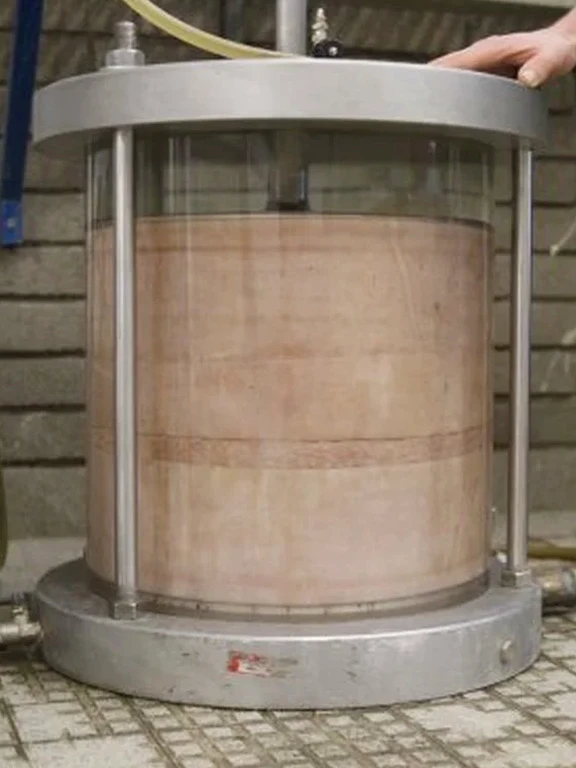
All laboratory procedures in the United States, and by extension New York State, are governed by standards established by ASTM International and AASHTO. Projects within Buffalo must adhere to the New York State Building Code, which references these consensus standards for geotechnical design. Whether determining moisture content per ASTM D2216 or performing a strength test, the chain of custody and quality control under an accredited lab's scope are mandatory for public works and recommended for private development. Compliance ensures that the data underpinning foundation recommendations meets the standard of care required by local reviewing agencies and professional engineering boards.
The types of projects that demand rigorous laboratory programs are diverse. Heavy infrastructure such as the Kensington Expressway reconstruction or new bridge piers over the Buffalo River requires precise strength and compressibility parameters. Commercial developments on the former industrial sites of Larkinville or along the Outer Harbor rely on laboratory analysis to characterize contaminated fill and design remediation. Even residential subdivisions in Clarence or Hamburg benefit from a laboratory CBR test to validate subgrade stiffness for pavements. For critical structures, a triaxial test provides the effective stress strength envelope essential for modeling soil behavior under complex loading, while a laboratory permeability test quantifies drainage characteristics for dewatering system design or seepage analysis.
Common questions
What is the purpose of a geotechnical laboratory testing program?
A laboratory program quantifies the physical, hydraulic, and mechanical properties of subsurface materials recovered from a site. It moves beyond visual classification to provide measured values for grain size, moisture-density relationships, shear strength, and compressibility. These parameters are essential for foundation design, slope stability analysis, and predicting how the ground will respond to structural loads and environmental changes over time.
Which ASTM standards are most commonly applied in Buffalo laboratories?
Local labs routinely follow ASTM D422 for particle-size analysis, D4318 for Atterberg limits, D698 or D1557 for compaction characteristics, D2435 for one-dimensional consolidation, and D4767 or D2850 for triaxial compression. For specific applications, ASTM D1883 governs the CBR test for pavement design, while D5084 regulates flexible-wall permeability testing. AASHTO T 99 and T 180 are also referenced for highway projects.
How do local glacial soils affect laboratory testing procedures?
Buffalo's glacial till often contains cobbles and boulders that require careful specimen preparation or large-scale testing. The laminated lacustrine clays are sensitive to disturbance, demanding high-quality Shelby tube sampling and specialized consolidation or triaxial testing at low strain rates. The presence of naturally occurring gypsum or calcareous cementation in some units can also influence moisture content and strength results if not properly addressed during testing.
How long does a typical laboratory testing schedule take?
The duration depends entirely on the project's scope and the tests required. Index tests like moisture content and Atterberg limits can often be completed within a few days. However, a full suite including consolidation and triaxial shear tests typically requires two to four weeks, as consolidation tests alone may need up to ten days per specimen depending on the soil's drainage characteristics and the load increments applied.