Slope engineering in Buffalo, New York, encompasses the analysis, design, and stabilization of natural and man-made inclines subjected to the region's unique geotechnical challenges. This category covers a comprehensive range of services essential for managing the risks associated with unstable ground, from initial site investigation through long-term monitoring. The significance of slope stability in Buffalo is heightened by the city's aging infrastructure, variable topography along the Lake Erie shoreline and the Niagara Escarpment, and the increasing frequency of heavy precipitation events. A thorough approach, beginning with a detailed slope stability analysis, is not merely a best practice but a critical requirement for protecting public safety, property, and environmental quality in both urban and suburban settings.
The local geology presents a complex interplay of glacial deposits, including stiff clay tills, glaciolacustrine silts and clays, and occasional sand and gravel layers overlying the bedrock of the Onondaga Limestone and Hamilton Group shales. These lacustrine soils, deposited in ancient glacial lakes, are particularly sensitive; they can exhibit significant strength loss when saturated or disturbed, a condition that has historically led to landslides along Buffalo's creek valleys and lake bluffs. The presence of expansive Queenston Shale in certain areas adds another layer of complexity, as it can weather rapidly upon excavation. This geological setting demands specialized investigation techniques to accurately characterize subsurface conditions before any design work can proceed, ensuring that a slope failure analysis is grounded in robust, site-specific data rather than generic assumptions.
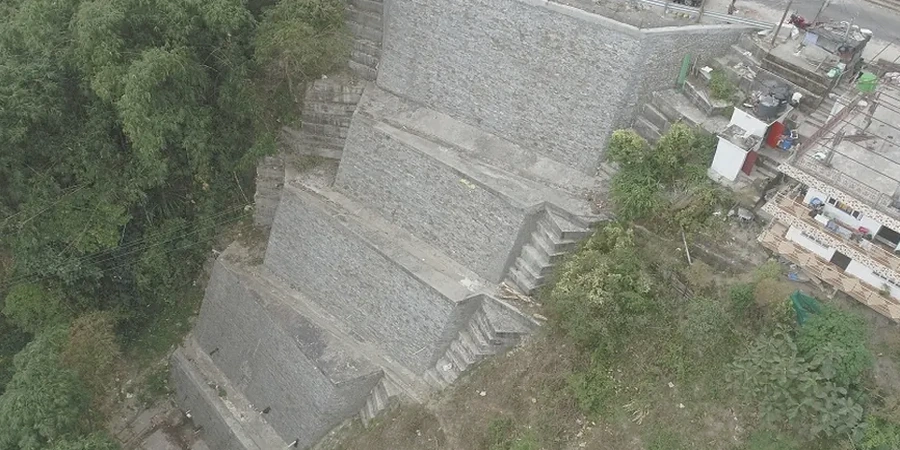
Regulatory compliance in Buffalo is governed by a combination of New York State codes and local municipal ordinances. The New York State Uniform Fire Prevention and Building Code, which adopts the International Building Code with state-specific modifications, sets the primary standards for geotechnical design, including Chapter 18 on Soils and Foundations. For earth-retaining structures, which are often integral to slope stabilization, a retaining wall design must adhere to these structural and geotechnical provisions. Projects that disturb more than one acre of land trigger the New York State Department of Environmental Conservation's Stormwater Management regulations, requiring an erosion and sediment control plan. In environmentally sensitive zones, such as those adjacent to the Buffalo River or Lake Erie, the Coastal Erosion Hazard Area regulations impose additional restrictions and design criteria to minimize shoreline degradation and habitat disruption.
The types of projects requiring these specialized services are diverse, ranging from public infrastructure to private development. Transportation corridors, including the I-190 and Route 5, frequently traverse challenging terrain where rock slope stabilization and soil nail walls are necessary to prevent roadway blockages. The redevelopment of Buffalo's historic industrial waterfront and the construction of new residential communities along the bluffs demand rigorous slope engineering to ensure long-term resilience. In situations where space is constrained or excavation depths are significant, a sheet pile wall design often provides an efficient and cost-effective solution for temporary or permanent earth support. Ultimately, the successful execution of any project involving a slope in the Buffalo area hinges on a proactive, integrated approach that combines thorough site characterization with robust, regulation-compliant design.
Common questions
What are the most common triggers for slope instability in the Buffalo area?
The primary triggers in Buffalo are excessive precipitation and rapid snowmelt, which saturate the ground and increase pore-water pressure, particularly in the sensitive glaciolacustrine silts and clays. Other common causes include poor drainage management, uncontrolled excavation at the toe of a slope, and erosion from Lake Erie wave action along the shoreline bluffs.
What is the typical process for assessing a potentially unstable slope on my property?
The process begins with a visual site reconnaissance by a geotechnical engineer to map features like scarps, tension cracks, and seeps. This is followed by a subsurface investigation involving soil borings and laboratory testing to define soil strength parameters. A slope stability analysis is then performed using these data to calculate the factor of safety and determine the risk of failure.
Which local regulations govern slope stabilization and retaining wall construction in Buffalo?
Slope stabilization projects are primarily governed by the New York State Uniform Code, which enforces the International Building Code Chapter 18 for geotechnical design. Work near water bodies requires NYSDEC permits, and projects within designated Coastal Erosion Hazard Areas along Lake Erie have additional setback and design requirements to protect against erosion and bluff collapse.
What are the key differences between a gravity retaining wall and a sheet pile wall for slope support?
A gravity retaining wall uses its own mass to resist lateral earth pressures and is suitable for lower heights where a wider construction footprint is acceptable. A sheet pile wall consists of interlocking steel sections driven into the ground, making it ideal for tight spaces, waterfront applications, and deeper excavations where a lightweight, cantilevered or anchored solution is required.