Buffalo sits on a thick sequence of glacial till and lacustrine clays deposited by ancient Lake Iroquois. These soils often exhibit variable moisture content and low natural strength. Laboratory CBR testing provides a direct measure of subgrade bearing capacity for pavement and foundation design. We follow ASTM D1883 to soak and penetrate compacted specimens under controlled conditions. The method replicates worst-case saturation, which is critical for Buffalo's freeze-thaw cycles and spring thaws. Before the CBR test, a proper soil classification is essential to interpret results correctly. That is why we always recommend a full classification of soils alongside the CBR test to correlate behavior with plasticity and gradation. Our lab prepares samples at optimum moisture from Proctor compaction, then measures penetration resistance. This data directly feeds into flexible pavement thickness design per AASHTO guidelines. In Buffalo, where seasonal frost penetrates up to 40 inches, knowing the soaked CBR value prevents premature pavement failure in residential streets and industrial yards alike.
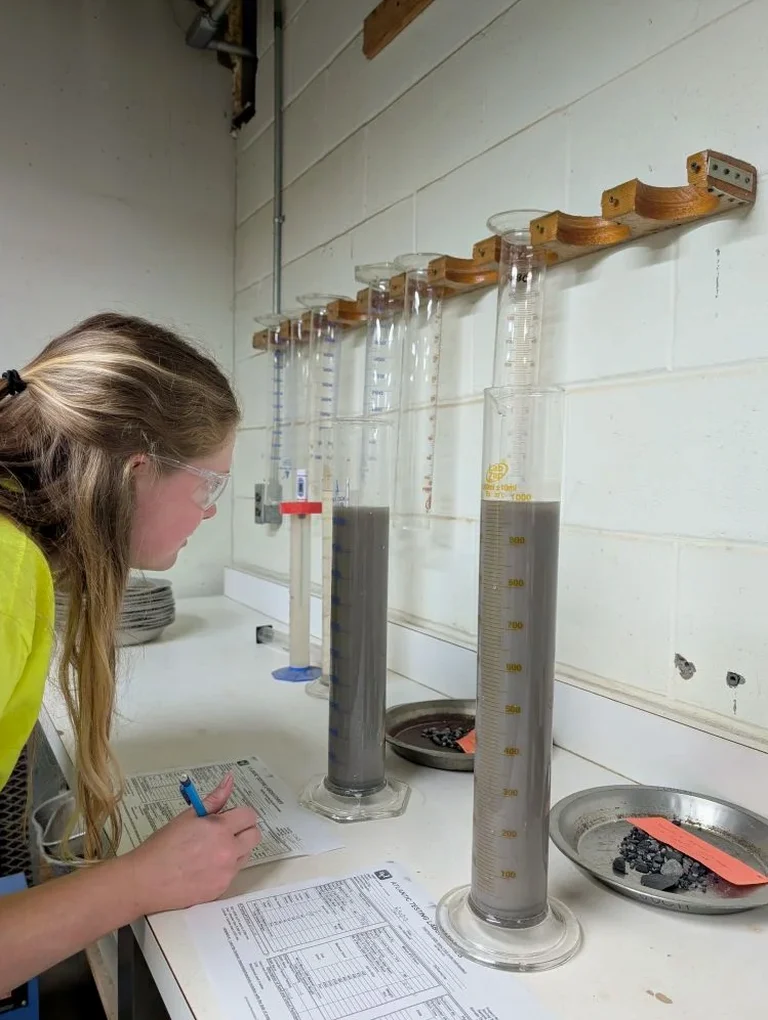
A soaked CBR below 5 in Buffalo's glacial till often requires subgrade improvement or a thicker pavement section to avoid rutting and cracking.
Method and coverage
Regional considerations
Buffalo averages 94 inches of snow per year, and the ground freezes deep. When the spring thaw arrives, meltwater saturates the subgrade. A low CBR means the soil can deform under traffic loads. In our experience, projects that skip laboratory CBR testing often face early rutting and alligator cracking within two to three winters. The city's industrial zones, like the Buffalo Lakeside Commerce Park, see heavy truck traffic that amplifies subgrade stress. Without a proper CBR value, pavement thickness designs are guesses. That guesswork leads to either overbuilt sections — wasted money — or underbuilt sections — premature failure. We have seen residential driveways in North Buffalo fail within one season because the contractor assumed a CBR of 10 when the actual value was 4. The laboratory CBR test removes that uncertainty. It gives engineers a defensible number. For a city that invests heavily in infrastructure renewal, that number protects public funds and extends service life.
Standards that apply
ASTM D1883-21, AASHTO T 193-13, ASTM D698-12 (Standard Proctor)
Complementary services
Standard CBR Test (ASTM D1883)
Single-point CBR on compacted specimen at optimum moisture. Includes 96-hour soak, swell measurement, and penetration curve. Ideal for preliminary pavement design and local road projects. Turnaround: 5 business days.
CBR with Variable Compaction Effort
Multiple specimens compacted at varying energy levels (standard, modified, reduced) to evaluate sensitivity to compaction. Includes expansion index and full report with recommendations. Recommended for heavy-traffic corridors and industrial pavements in Buffalo.
Typical parameters
Process video
FAQ
What is the difference between laboratory CBR and field CBR?
Laboratory CBR is performed on remolded, compacted specimens under controlled moisture and density conditions following ASTM D1883. It simulates worst-case saturation after soaking. Field CBR is an in-situ test using a mobile loading frame. Lab values are more repeatable and are used for pavement design, while field tests are faster for quality control. In Buffalo's variable glacial till, we recommend lab CBR for design and field CBR for verification during construction.
How much does a laboratory CBR test cost in Buffalo?
A standard laboratory CBR test with one compaction effort and 96-hour soak typically ranges from US$150 to US$230 per sample. Additional compaction efforts, swell measurements, or rush processing increase the cost. Volume discounts apply for multiple samples from the same project. Contact us for a quote specific to your material and schedule.
Do I need a CBR test for a residential driveway in Buffalo?
Yes, especially if the driveway will support heavy vehicles like delivery trucks or snowplows. Buffalo's silty clay subgrade can lose strength dramatically when wet. A soaked CBR test tells you the minimum bearing capacity during spring thaw. For a typical residential driveway, a CBR of 5 or higher is desirable. If the value is lower, your contractor needs to increase pavement thickness or stabilize the subgrade with lime or geogrid. Skipping this test often leads to cracking and settlement within two winters.