We roll into Buffalo with our CME 55 truck-mounted drill rig, the kind you see on residential streets in North Buffalo or near the Outer Harbor. It drives a 2-inch split spoon sampler to recover soil at 1.5-meter intervals. That sampler tells us density in sands and consistency in clays — the core of any soil mechanics study. Before we start, we check utility clearance with Dig Safely New York. Then we advance a hollow-stem auger to refusal or target depth, usually 25 to 40 feet for typical two-story buildings. The driller logs each run while our field engineer bags disturbed and undisturbed samples. We also run a MASW survey alongside borings when the site sits on known glacial till lenses, because shear-wave velocity profiles help confirm site class per ASCE 7. Each boring gets sealed with bentonite grout after completion. We label everything and ship to our lab in Cheektowaga within 24 hours.
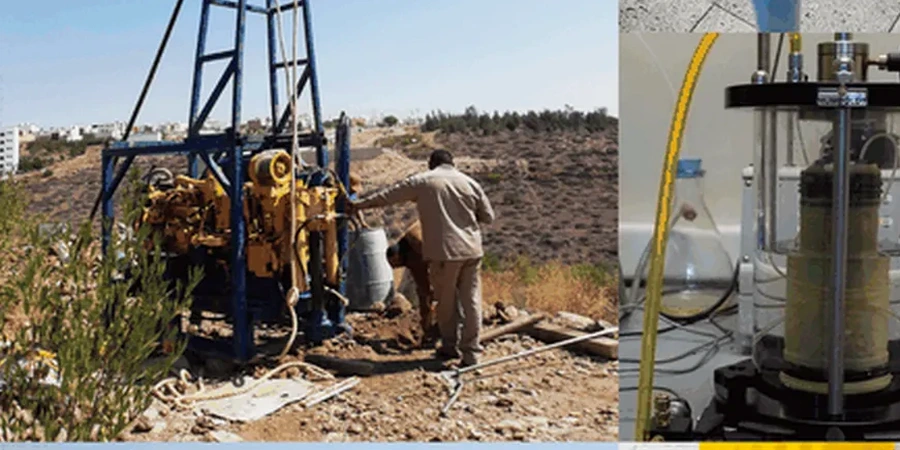
Glacial till under Buffalo can hide cobble layers that stop SPT sampling cold. We log blow counts carefully to distinguish between dense till and refusal.
Method and coverage
Regional considerations
Buffalo sits in Seismic Design Category B per IBC, so ground shaking is moderate, not extreme. But the real risk is liquefaction in loose saturated sands and soft clays along the lake plains. The soil mechanics study must evaluate cyclic stress ratios using NCEER procedures from Youd-Idriss (2001). We also check for collapse potential in old fill near the Buffalo River. If the study flags a liquefaction hazard, we recommend Improvement like stone columns or deep dynamic compaction. Another common issue is expansive clay beneath slab-on-grade floors. We measure swell pressure and recommend subgrade replacement or chemical stabilization. Ignoring these risks often leads to cracked foundations, uneven floors, and costly repairs within five years. That is why every report we deliver includes a clear risk summary with specific mitigation measures.
Standards that apply
ASTM D1586-18 Standard Test Method for Standard Penetration Test, ASTM D4318-17 Standard Test Methods for Liquid Limit, Plastic Limit, and Plasticity Index of Soils, ASTM D2487-17 Standard Practice for Classification of Soils for Engineering Purposes, IBC 2021 Section 1803 Geotechnical Investigations, ASCE 7-16 Minimum Design Loads and Associated Criteria for Buildings
Complementary services
Subsurface Site Investigation & Boring Logging
We drill 4 to 8 borings per site using hollow-stem auger or mud rotary. Each boring includes SPT at 1.5-m intervals, undisturbed tube sampling in clay, and bedrock coring when needed. We classify soil visually in the field and photograph every core box.
Laboratory Testing & Foundation Recommendations
Our AASHTO-accredited lab runs classification, strength, and consolidation tests. We deliver a report with bearing capacity for shallow and deep foundations, settlement estimates, lateral earth pressures, and seismic site classification per IBC. All data is cross-referenced with boring logs.
Typical parameters
Process video
FAQ
How long does a typical soil mechanics study take in Buffalo?
For a standard residential or small commercial site with 4 borings, field work takes 1 to 2 days. Lab testing adds another 5 to 7 business days. The full report is usually ready within 10 business days from the start of drilling.
What is the cost range for a soil mechanics study in Buffalo?
The cost typically ranges between US$ 2,970 and US$ 5,450 depending on the number of borings, depth, and lab tests required. A basic study for a single-family home with 2 borings to 20 feet falls at the lower end. A commercial site with 8 borings and full triaxial testing sits near the top of that range.
Does Buffalo's lake-effect snow affect when you can drill?
Yes, heavy snow and frozen ground can delay drilling. We usually work from April through November for most projects. In winter, we mobilize with heated shelters and thawing equipment, but deeper frost penetration of 2 to 3 feet can slow production. We advise scheduling fall soil studies ahead of spring construction.
What foundation type is most common for Buffalo's clay soils?
For the soft clay and glacial till profile, shallow spread footings work for light structures if the bearing capacity exceeds 2,000 psf. For heavier buildings, we often recommend deep foundations such as driven H-piles or auger-cast piles to reach the dense till or bedrock. We also see mat foundations on sites with high settlement risk.