Inside the geotechnical lab in Buffalo, the falling-head and constant-head permeameters sit ready for the glacial till and lacustrine clays that define the region's subsurface. A technician prepares a remolded sample of the native silty clay, trimming it exactly to fit the permeameter cell. The constant-head setup works best for the coarser sands found near the Niagara River, while the falling-head method handles the low-permeability tills that cover much of Erie County. Each test follows ASTM D2434-22, with data logged to produce a coefficient of permeability (k) value that directly influences drainage design for basements, retaining walls, and excavated slopes. Before scheduling the test, the team reviews the project's soil classification from the study of soil mechanics to select the appropriate method.
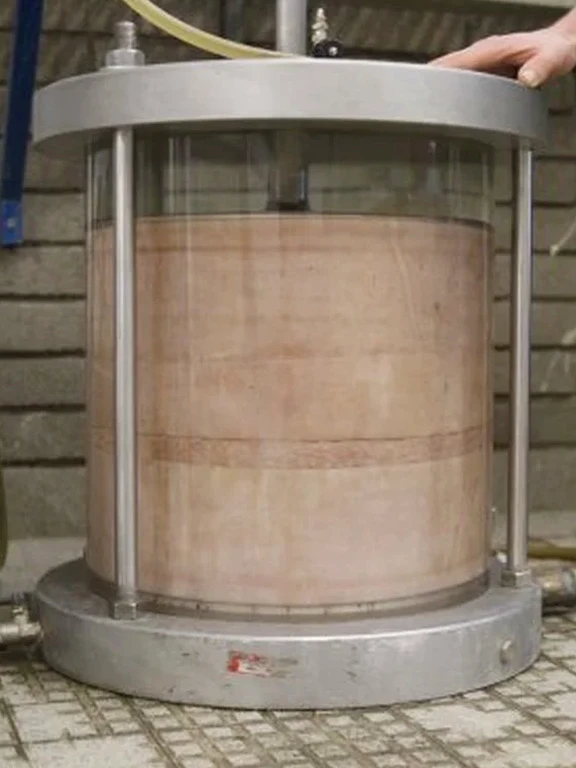
A single permeability test can prevent a basement excavation from turning into a pond, saving weeks of dewatering costs in Buffalo's glacial till.
Method and coverage
Regional considerations
Buffalo sits atop a complex sequence of glacial till, lacustrine clays, and alluvial sands deposited by retreating ice sheets. The till layers, often more than 30 feet thick in the suburbs, have extremely low permeability — sometimes below 10⁻⁷ cm/s — which traps water above them. When excavation cuts into these clays, the perched water table can cause rapid slope failures or hydrostatic uplift on basement slabs. A falling-head permeability test reveals exactly how fast water can migrate through these strata, allowing engineers to design dewatering systems or drainage blankets that match the actual soil behavior. Without this data, the risk of post-construction settlement or wet basements jumps considerably.
Standards that apply
ASTM D2434-22 (Constant Head Permeability), ASTM D5856-15 (Falling Head Permeability), ASTM D422-63 (Particle Size Analysis), ASTM D2487-17 (Unified Soil Classification System)
Complementary services
Triaxial Permeability Testing
Measures permeability under confining stress, simulating the in-situ stress state of deep foundation layers in Buffalo's glacial till.
Flexible Wall Permeability Test
Uses a latex membrane to prevent sidewall leakage, ideal for low-permeability clays where a 1x10⁻⁸ cm/s reading is critical for landfill liner design.
Constant Head Permeability on Sands
Targeted at the coarser alluvial deposits near Buffalo's waterfront, providing k-values for dewatering well design and groundwater modeling.
This service complements our laboratory testing work for a complete project analysis.
Typical parameters
FAQ
What is the difference between falling-head and constant-head permeability tests?
Falling-head is used for fine-grained soils (silt, clay) where water moves slowly through the sample, while constant-head is preferred for sands and gravels that allow steady flow under a fixed hydraulic gradient. Both methods yield the coefficient of permeability (k), but the choice depends on the soil type encountered at the Buffalo site.
Why do I need a laboratory permeability test for my Buffalo project?
Buffalo's glacial till and lacustrine clays can trap water unpredictably. A lab test provides a reliable k-value that drives drainage design, dewatering plans, and slope stability analysis. Without it, you risk underestimating seepage rates and facing costly delays during excavation.
How much does a laboratory permeability test cost in Buffalo?
The typical cost ranges between US$440 and US$650 per sample, depending on the method (falling vs. constant head) and whether the sample is undisturbed or remolded. Bulk discounts apply for multiple samples from the same project.
What sample preparation is required for a falling-head permeability test?
The lab requires undisturbed Shelby tube samples or remolded specimens compacted to the field density. The sample must be fully saturated before testing — achieved by back-pressure saturation — to ensure the measured k-value reflects the in-situ condition of Buffalo's low-permeability tills.